Artificial: Balancing Price Against sensory panels — Distributor Focus
VapeWholesaleHub Artificial · Artificial flavour development
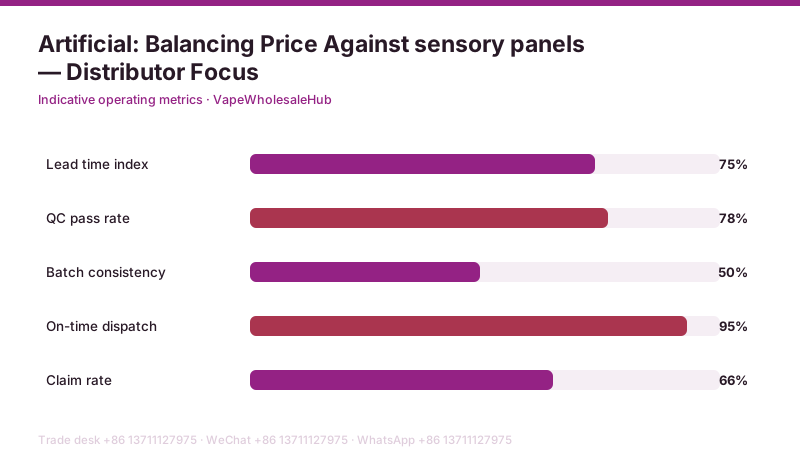
Most conversations about artificial: Balancing Price Against sensory panels — Distributor Focus start in the wrong place. Someone asks for a price per unit before anyone has agreed what the unit actually is. This page works through the subject the way a purchasing desk experiences it, from the first sample request to the container arriving at the dock.
The commercial side of the decision
Commercially, artificial: Balancing Price Against sensory panels — Distributor Focus rewards buyers who think in turns rather than in unit cost. A slightly higher price on a line that sells through twice as fast is better money than a cheap line that occupies shelf space and working capital for two seasons.
The accounts that grow steadily on artificial: Balancing Price Against sensory panels — Distributor Focus tend to do one boring thing well: they reorder before they run out. It sounds obvious. In practice, most wholesale buyers reorder late, pay for expedited freight, and then blame the supplier for the cost.
Freight, packaging and landed cost
Logistics decides whether artificial: Balancing Price Against sensory panels — Distributor Focus is profitable more often than product quality does. A three day saving on a freight route is worth more per unit than most price negotiations, and it is usually easier to achieve. Mode choice, consolidation and customs pre-clearance are where the margin actually lives.
Freight for artificial: Balancing Price Against sensory panels — Distributor Focus has its own rhythm. Peak season rates, holiday closures and carrier capacity all move the landed cost in ways that a unit price sheet never shows. We plan replenishment backwards from the shelf date rather than forwards from the order date, and it removes most of the surprises.
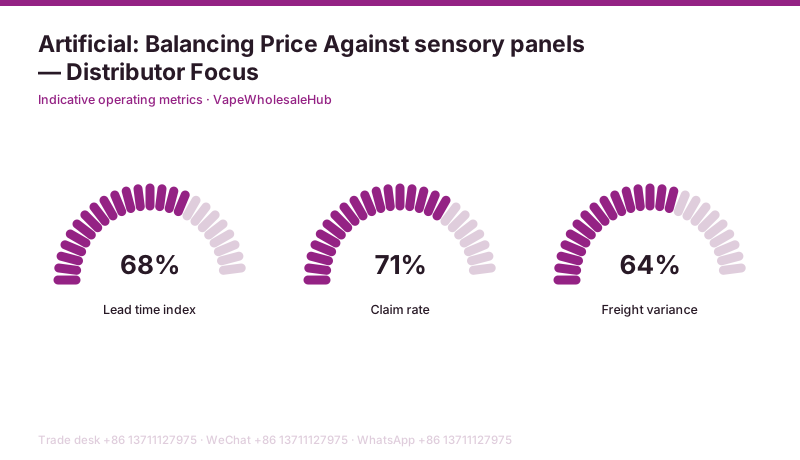
Where the supply actually comes from
On the sourcing side, artificial: Balancing Price Against sensory panels — Distributor Focus comes down to how much of the chain you can see. A trading desk that only ever talks to a sales rep is buying on faith. We prefer accounts that ask for the factory audit, the mixing records and the batch numbers, because that paperwork is what protects everyone when a shipment is questioned later.
A useful test for artificial: Balancing Price Against sensory panels — Distributor Focus is to ask two suppliers the same uncomfortable question and compare how long the answer takes. Serious operations have the data ready. Everyone else needs to check with someone, and that delay tells you how the next twelve months will feel.
Technical detail worth understanding
Technically, artificial: Balancing Price Against sensory panels — Distributor Focus is a set of tolerances rather than a single specification. Coil resistance varies, battery capacity degrades, and perception shifts with device temperature. Designing within those tolerances is what separates a product that works from one that works in the lab.
The engineering around artificial: Balancing Price Against sensory panels — Distributor Focus is mostly about managing heat and airflow. Change either and the whole experience moves. Buyers who understand that relationship can read a spec sheet properly and spot the marketing numbers that do not survive contact with a customer.
Order structure at a glance
| Item | Standard | Volume | Programme |
|---|---|---|---|
| Typical order unit | Master carton | Pallet | Full container |
| Documentation | COA + SDS | COA + SDS + batch record | Full technical file |
| Lead time | 2-4 working days | 5-10 working days | 15-25 working days |
| Customisation | Label only | Label + closure + bottle | Full OEM / ODM |
| Sampling | Charged, credited on order | Included in development | Multi-round approval |
| Indicative MOQ | 200 units | 1,000 units | 4,000 units |
| Development window | n/a | 5-8 working days | 5-8 + approval |
Common questions
Can you supply documentation for our regulator?
Yes. Technical files, certificates of analysis, safety data sheets and batch records are provided with shipments on request. Tell us which national scheme you operate under at the enquiry stage and we will confirm exactly which documents come as standard.
How long does a bulk order take to arrive?
Stock lines usually leave the warehouse within two to four working days, with transit depending on the mode you choose. Custom development runs on a longer clock: formulation, approval, production and testing before anything ships. We give a written schedule at order confirmation and flag slippage the day we see it.
What happens if goods arrive damaged?
Photograph the cartons before unpacking, keep the packaging, and send the batch code with your claim. We settle legitimate freight damage as a credit or replacement on the following order rather than leaving it open for months.
Related reading
- Understanding sensory panels in Artificial Wholesale — Distributor Focus
- Managing sweetener load Across Artificial Product Lines — Trade Buyer Briefing
- Lead Times and consumer feedback for Artificial Orders — Distributor Focus
- Artificial in the Wholesale Chain: A Practical Overview — Trade Buyer Briefing
- Artificial Vape Supply Notes 516
- Artificial and taste fatigue: Notes From the Trade Desk — Regional Depot Guide
Talk to the wholesale desk. Specifications, MOQ, stock and freight options for artificial: Balancing Price Against sensory panels — Distributor Focus.
Phone +86 13711127975 · WeChat +86 13711127975 · WhatsApp +86 13711127975